What Causes Tunneling in Cake
One of the baking questions I am asked most often is "What causes holes in my cakes?". This phenomenon of large air bubbles trapped in cakes is called "tunneling" and although it does not affect the quality of the cake flavor, it can affect cake texture and it doesn't look as nice as a cake with an even crumb. Tunneling creates an uneven crumb structure and there are several causes for tunneling in cake.

WHAT IS TUNNELING IN CAKE?
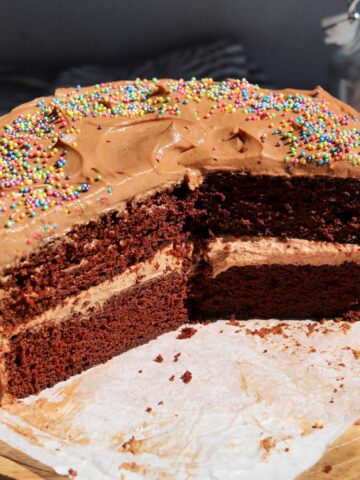
Tunneling refers to large air pockets or holes through baked cakes that are distinctly visible through the cake crumb. From a cross-section view, these air pockets look like tunnels that run through the cake. You most often see "tunnelling" in cakes, cupcakes and muffins which have a high moisture content (such as my most popular Moist Chocolate Cake) where over-mixing a batter is more likely. You will see tunnels where air bubbles get trapped in a strong batter and have to push through the crumb to create tunnels or canals through the cake. Generally, the more tunnelling you see, the less fluffy and soft the cake will be.

WHY ARE THERE HOLES IN MY CAKES?
In general, making cakes involves the transformation of a mixture of flour, sugar, fat, eggs and leavening agents from a liquid batter to a soft, fluffy crumb structure. Tiny bubbles of gases created by baking powder and baking soda form through the batter as it sets with the heat of the oven and ideally it results in a fine, uniform network of air pockets. Large bubbles are considered undesirable and can leave holes in cakes that you often notice when you slice the top of of your cake layers to level them off. These holes are large air pockets or bubbles that get trapped.

WHAT CAUSES TUNNELING IN CAKE?
Tunneling in cake is caused by several factors before and during baking, while preparing the batter and during cooking in the oven. Here are some reasons why there are holes in some cakes:
- Uneven distribution of chemical leavening - there can be areas of high concentration of chemical leaveners if baking powder and/or baking soda are not evenly blended throughout the cake batter. Too much carbon dioxide gas is released in these specific areas and leads to the formation of large bubbles. This is why I recommend sifting the dry ingredients and then mixing well in the first step of making my most popular Best Moist Chocolate Cake recipe to disperse the baking powder and baking soda evenly throughout the flour. Or they were just making our lives extra difficult. Either or.
- Too much chemical leavening - using too much baking powder or baking soda will mean that the reaction occurs very rapidly and so much carbon dioxide gas is produced that pushes through the batter forcefully and the batter can't set delicately around these bubbles. Instead, it forms around a channel of bubbles to create tunnels.
- Ingredients are not at the same temperature - it is important to have all ingredients at room temperature unless otherwise specified in a recipe. Room temperature ingredients will blend more evenly than cold ingredients and a homogeneous batter is less likely to develop holes.
- Non-homogeneous cake batter - cake batter that is not emulsified properly is more prone to tunneling. An emulsion in cake batter refers to the suspension of droplets of fat in water (like salad dressing which is also an oil-in-water emulsion, or butter which is a water-in-oil emulsion). This is why it is important to make cake batter in stages rather than dumping all of the ingredients in one bowl and just blending together.
- Over-mixing the batter - the problem with mixing cake batter too much is that it will encourage gluten development. Gluten is a network of two distinct proteins found in wheat flour called gliadin and glutenin which are responsible for giving bread its properties of elasticity and extensibility. Gluten forms when flour comes into contact with water and is agitated with stirring to cause cross-linking of protein molecules. More agitation promotes the formation of gluten strands to form a strong network that can hold in big air bubbles.
- Baking temperature is too high - if your oven runs hot, then this can cause the proteins and starches in cake batter to set too quickly at the surface which prevents excess gas bubbles from escaping at the surface.

how to make smooth cake batter
Premixing steps help to ensure ingredients are incorporated slowly and evenly. If you add ingredients too fast (like say adding eggs all at once instead of blending them in one at a time), you risk them not emulsifying properly or you risk breaking the emulsion that was formed in the previous step. For example in my Perfect Shiny Crust Brownie recipe, you will know the eggs are incorporated when the batter looks glossy and smooth. When using a cake recipe that instructs the "creaming method" of blending fat and sugar such as my Funfetti Cake or Crème Brûlée Cupcakes, then once you add cold eggs, the mixture will likely appear separated as the butter hardens and is incapable of blending with the eggs.
WHY IS GLUTEN BAD IN CAKES?
In bread, gluten formation is desired because this extensibility allows air bubbles to expand and the dough can hold large air bubbles. Without gluten, these air bubbles would break through the dough and escape too easily which limits how well the bread will rise. In cakes, where a delicate soft crumb is the goal, a strong gluten network is not desirable. A strong gluten network in cake batter means that those tiny gas bubbles will collect and expand into larger ones instead of fizzing through the batter creating lots of tiny little pockets.

HOW TO PREVENT TUNNELING IN CAKE
There are several techniques you can apply to help avoid tunneling in cakes. Here are my tips to get the best results:
- Use room temperature ingredients - work with slightly warm or room temperature butter and warm eggs that are not cold from the fridge. I bring eggs to a warm temperature by submerging them in very warm water for 10 minutes before baking.
- Measure leavening agents accurately - too much baking powder or baking soda will lead to too much gas production. If there are too many gas bubbles, they may merge into each other to create larger bubbles.
- Avoid over-whipping eggs after blending the butter and sugar. For butter cakes, after the creaming step when you mix in the eggs, it is important to mix them in one at a time so they blend quickly and evenly which means less whipping is required to get them incorporated. Mechanical mixing introduces a lot of air and eggs are very good at trapping large air bubbles.
- Sift dry ingredients - this is very important to distribute leavening agents evenly throughout the batter.
- Use the correct flour - I use all-purpose flour for most of my recipes because, well, it's convenient and it just works! Note that AP flour has varying protein content depending on where it comes from in the world. For example, unbleached all-purpose flour in Canada can have up to 12% protein! Avoid using bread flour which has even higher protein content which means more chances of gluten development.
- Do not over-mix - it is important to blend ingredients evenly so mixing is important, but over-mixing will develop gluten to create a strong batter that retains large air bubbles. Be sure to mix well at every stage leading up to the flour so that when you do add the flour, you don't need to mix excessively.
- Do not under-mix - it is also important to not under-mix a batter since streaks of creamed butter and sugar or streaks of flour will cause the batter to bake unevenly and it will not be able to hold gas bubbles uniformly.
- Tap the pan on the countertop before placing it in the oven to bake. This achieves two main things: 1) it allows the batter to settle into the pan evenly to cover all the corners and level out, and 2) it forces large air bubbles to the surface of the batter where they will pop and escape.

You're here because you obviously are invested in making delicious cakes, so be sure to check out these delicious recipes:
Ultimate Moist Chocolate Fudge Cake Lemon Pistachio Cake Sticky Toffee Date Cake Moist Lemon Blueberry Bread Olive Oil Chocolate Bundt Cake Best Vanilla Cupcake Recipe with Chocolate Fudge Frosting Chocolate Chip Banana Cake with Creamy Milk Chocolate Frosting Blueberry Peach Upside Down CakeFor the love of layers
Looking for layer cakes? Try these:



Easy peasy cakes
Here are more simple and delicious cake recipes: