
Lemon Blueberry Sweet Rolls
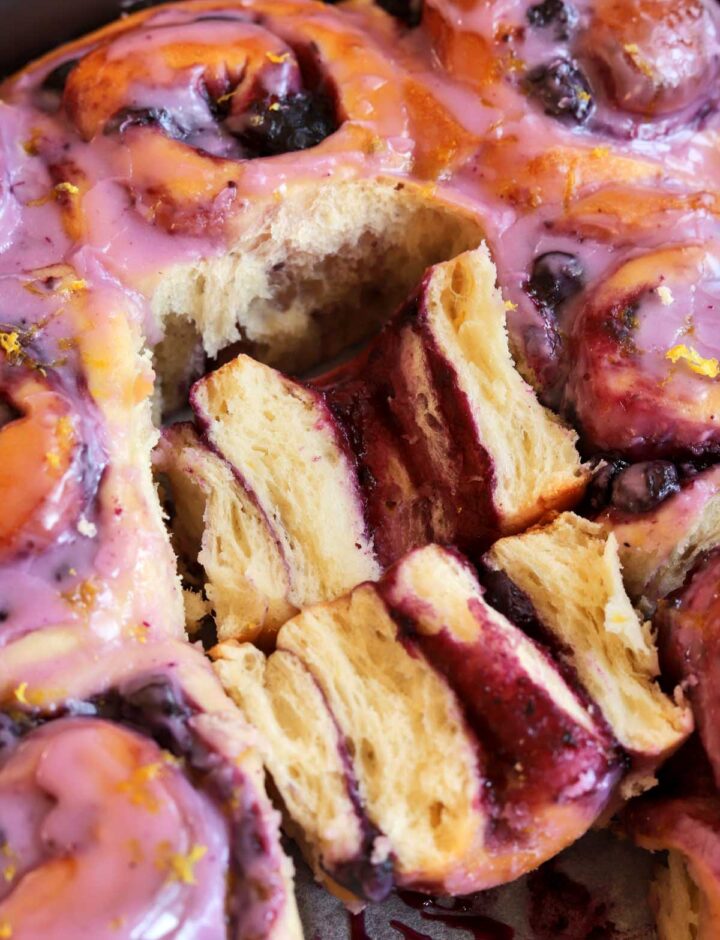
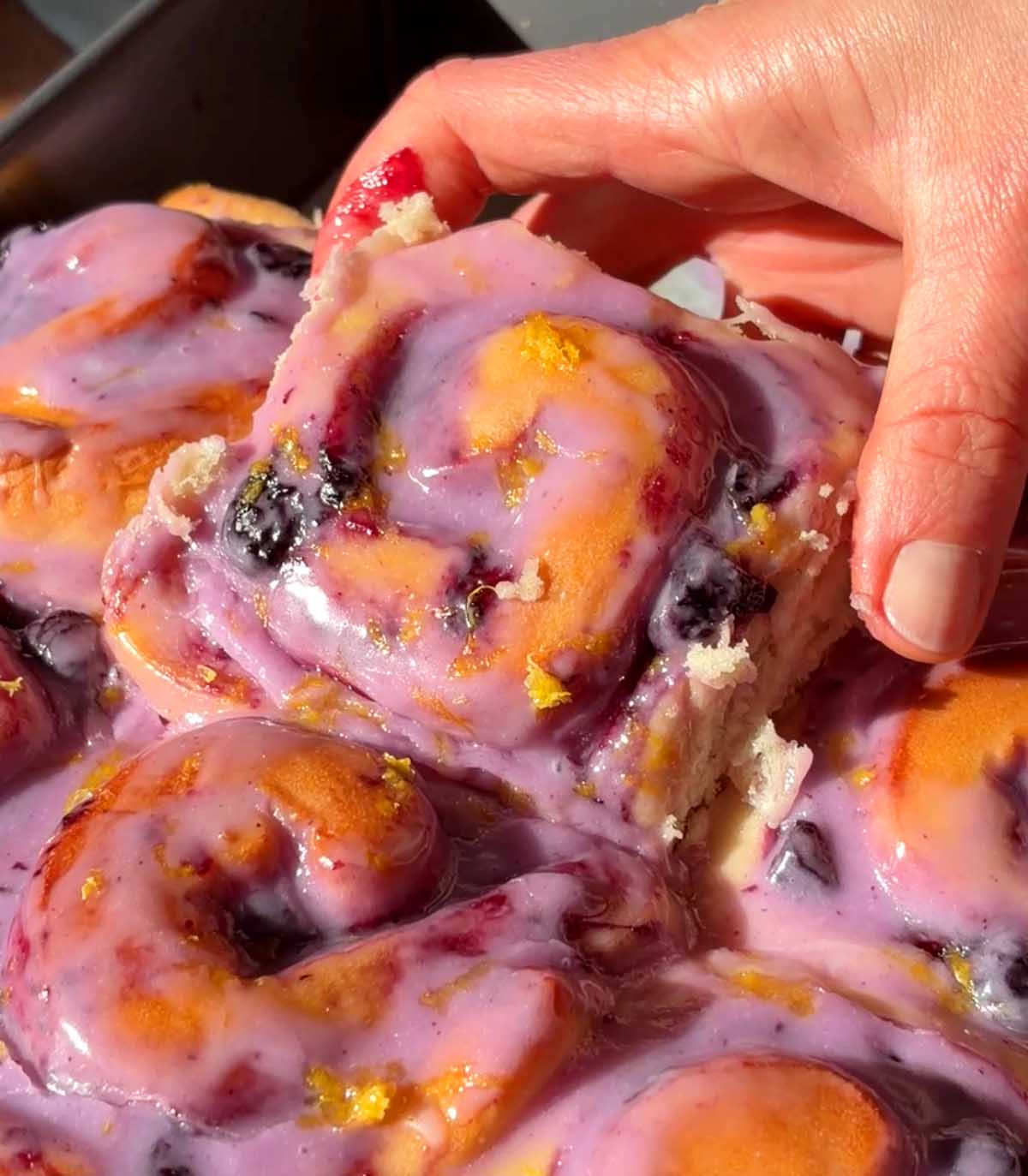
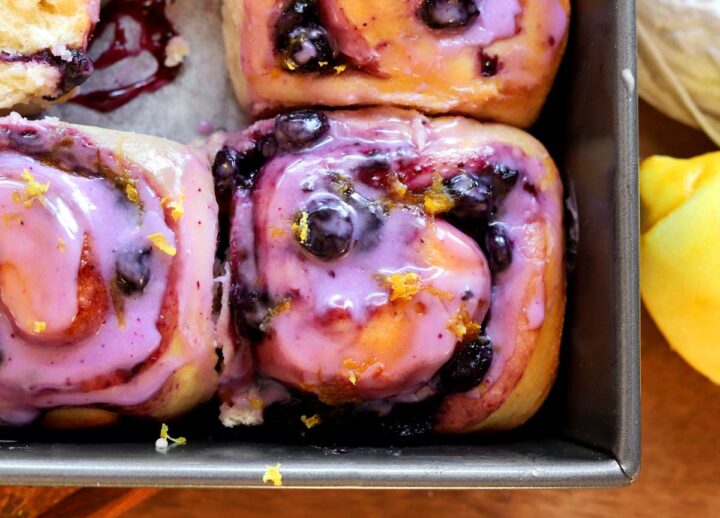
These Lemon Blueberry Sweet Rolls are so soft, full and fluffy that you will think they've come from a high end bakery. They have the most incredible tender and airy crumb texture with juicy blueberry filling in every bite, then topped with a tangy blueberry glaze. The dough is infused with lemon zest and the flavor comes through so well. If you've tried my popular Cinnamon Rolls with hundreds of 5 star reviews from professional bakers, then you just know how good these blueberry rolls will be! I have developed this recipe in partner with my husband who is also a Food Scientist that specializes in bread, so you can be assured that this is a recipe that works. There are no fancy tricks, just good technique and I break down all the science for you in this article so you can make fresh buns at home any time and enjoy the pleasure of eating them fresh and warm from the oven.
WHY THIS RECIPE WORKS
- Easy to make - this is a very simple recipe with thoughtful proportions. You combine all of the dough ingredients and knead until it becomes very smooth and gluten is well developed. This dough rises only once (single bulk fermentation) and then a short rise in the pan after they are formed.
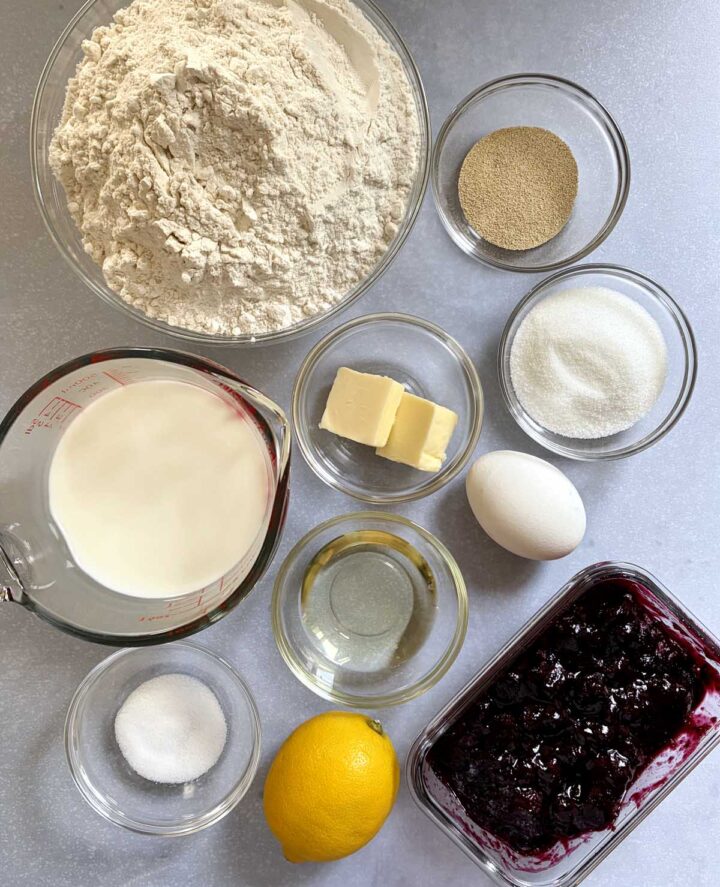
- Simple ingredients - you just need basic pantry ingredients to make great sweet rolls. Flour, yeast, egg, butter, milk, oil and salt are the main ingredients. Fresh lemon zest brings all the floral citrus flavor to the dough!
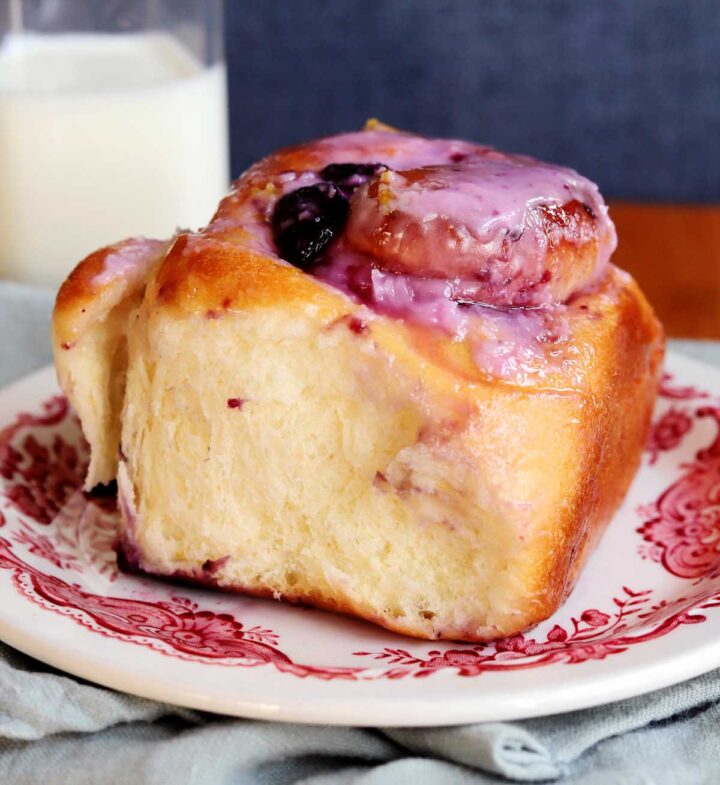
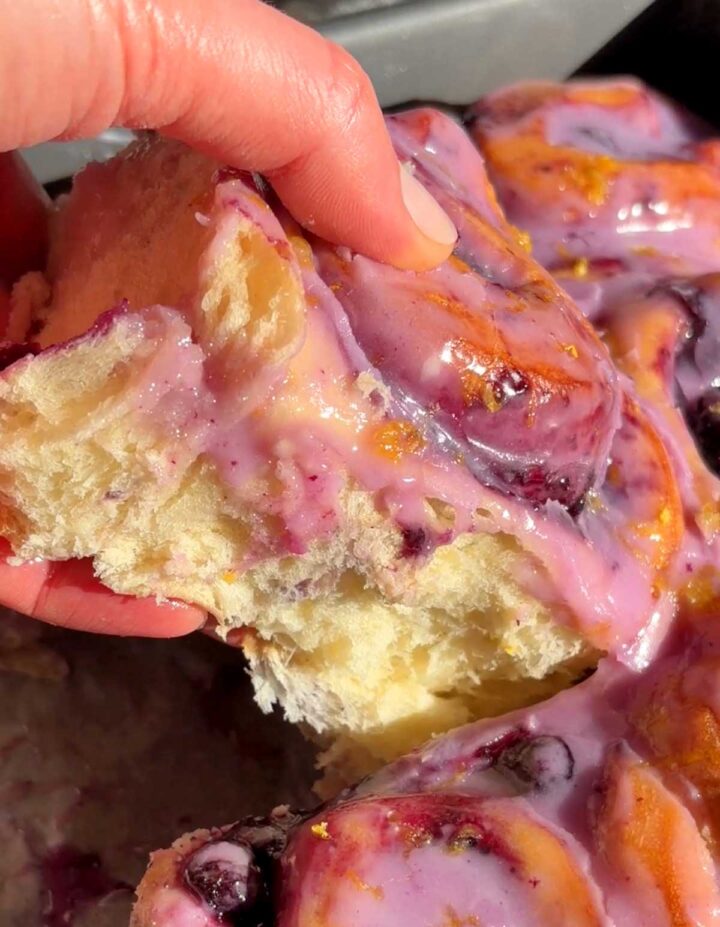
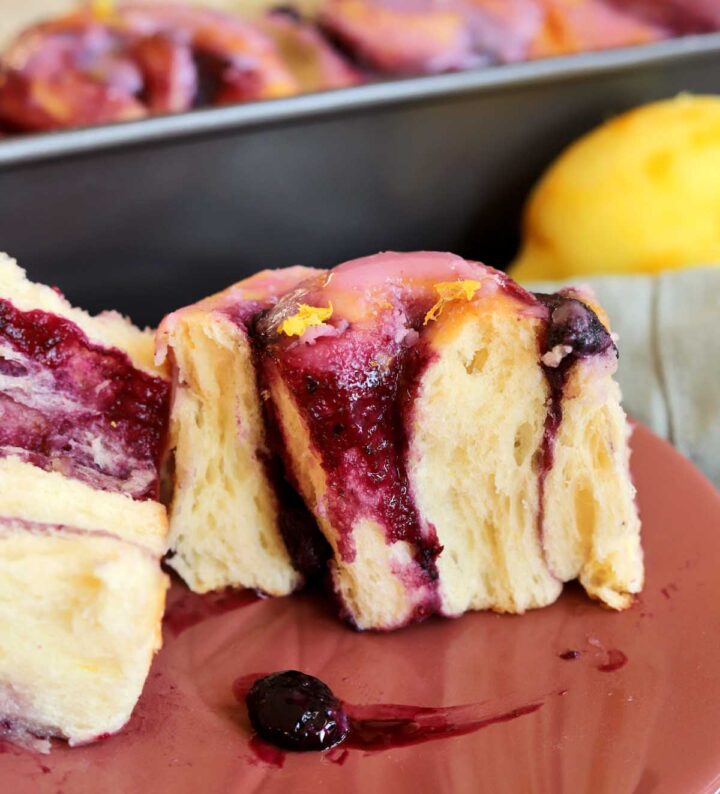
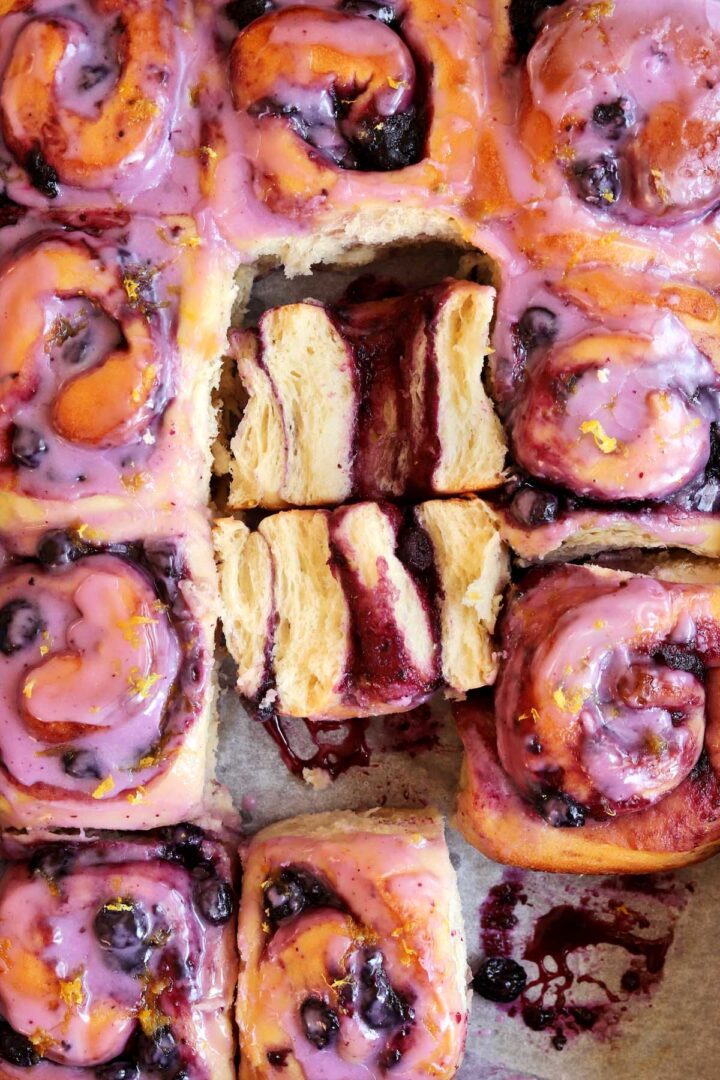
- Soft and fluffy texture - you will love how soft and fluffy these rolls are! They are not dense, gummy and pasty like I find some sweet rolls can be if the dough is too weak and not strong enough to hold the air.
- Big puffy rolls - this recipe makes 12 nice puffy rolls from a modest amount of dough and that's because it is designed with the right baker's proportions and kneaded thoroughly to have proper structure to hold in lots of air bubbles.
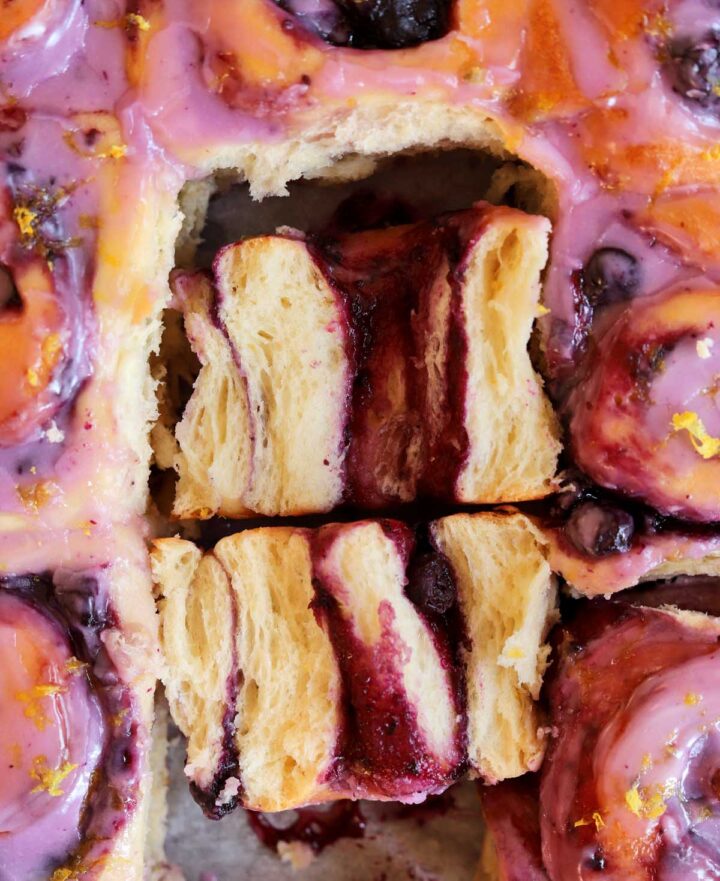
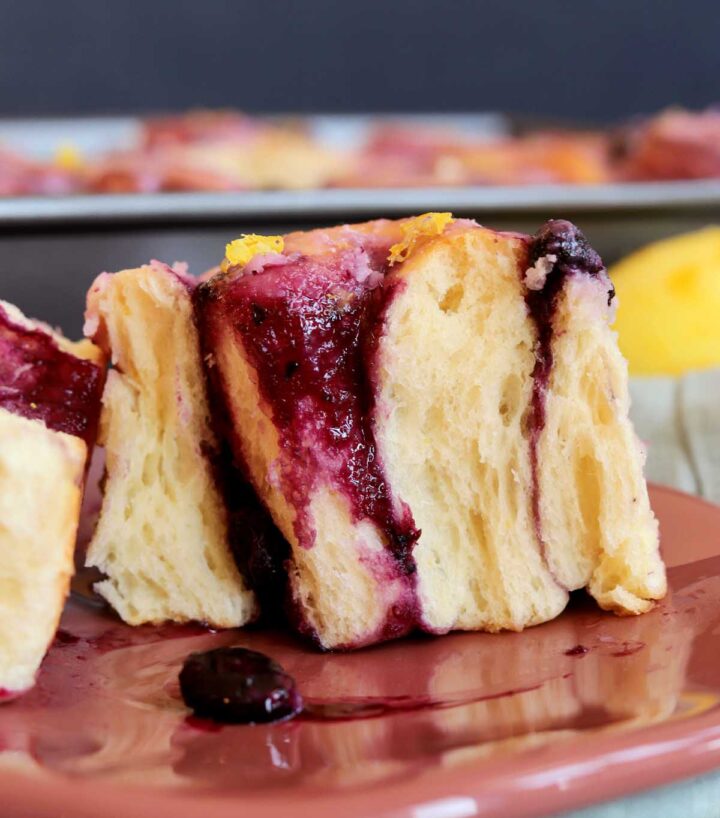
- Feathery dough - you'll see how the soft, fluffy buns just peel away so delicately which is a testament to their softness and structure. In the baking industry, this effect is called "feathering".
- Gooey blueberry filling - the lemon blueberry filling is sweet and tart and completely irresistible! It is so juicy and will hold inside the rolls without oozing out. Because it is a wetter filling than a cinnamon roll, it will be a bit messy to roll and shape, but it doesn't matter. Embrace the mess and just get the rolls in the pan the best you can. I promise they will turn out beautiful!
- No cream bath - a lot of viral sweet roll recipes bathe the dough in cream by pouring cream over the raw rolls in the pan before baking. This is not necessary to make good buns and I think it is a way to cheat so you don't over-bake them, but it can lead to dense gummy rolls.

INGREDIENTS FOR LEMON BLUEBERRY ROLLS
- Bread flour - I love to use bread flour for this recipe. Bread flour contains a higher protein content and also higher protein quality which means that has a greater ability to build strength in the dough to hold in air. Bread proteins, glutenin and gliadin, provide elasticity and extensibility to dough so it can expand and then hold in the gas bubbles created by yeast to make a fluffy and tender dough. All-purpose flour also works in this recipe, and the rolls will have slightly less volume.
- Butter - this sweet dough has a total of about 10% fat between the butter and oil. The flavor of butter is delicious, however its harder fat composition is not ideal for optimum softness in a classic sweet roll recipe. Much more than 10% fat has a negative effect on typical dough volume as it dilutes the gluten content, compromises the structure and prevents the dough from holding in gas.
- Oil - liquid oil helps lubricate gluten proteins so that they can expand and trap air for fluffier dough. Butter tastes great, however it will lend a firmer texture to the final rolls once cooled, and since there is plenty of butter in the filling, you won't miss the flavor.
- Granulated sugar - This recipe has 11% sugar on a baker's percentage. (A baker's percentage means it is based on the flour being 100% and not the total amount of dough with the water included). This amount suits this recipe because it is high enough to provide the right amount of sweetness and tenderness, but not so high that it will slow the yeast fermentation process. Too much sugar can hinder yeast.
- Eggs - you just need one large egg to add nice structure and spongy texture.
- Milk - I recommend using whole milk or 2% milk for this recipe. It is the main source of moisture to hydrate the dough. In combination with egg, this dough has about 62% hydration. Most recipes suggest heating milk to 105 degrees F to help activate the yeast, however the friction of your stand mixer is usually enough to warm up the dough. If you are making these in the winter in a cold climate, then warming the milk may be beneficial.
- Yeast - I use instant yeast which is so convenient because you do not need to proof it. You can add instant yeast directly to the dry ingredients as long as it is not in direct contact with the salt. Direct content with salt will inactivate the yeast. Red Star instant quick-rise yeast is great, and I also like Fleischmann's rapid rise yeast.
- Salt - this recipe has 1.5% salt and it is an important ingredient! Salt is not just for flavor in bread. Salt creates a more stable gluten network to hold more gas and provides greater volume. Typical breads have 2% salt, but I use slightly less for rich sweet breads like cinnamon rolls, sweet rolls and brioche.
- Blueberry filling - you'll make a quick blueberry filling with fresh or frozen berries, lemon juice and corn starch. It should be quite thick and needs to chill thoroughly so it holds up better as you roll up the dough. You can make it up to 3 days in advance.
ACTIVE DRY YEAST VS. INSTANT YEAST
Active dry yeast looks like little spheres and is larger than instant yeast which has smaller granules the size of white granulated sugar meant to dissolve easily. It requires rehydration or "blooming" because of the way it is processed, there is more dead yeast on the surface. Hydrating penetrates this layer so the active yeast, which is only about 30%, can thrive. Instant yeast does not require rehydration and you can add it directly to the dry ingredients when making breads. Since it is smaller, there is more surface area so it dissolves readily. Instant yeast is processed in a way that makes it more viable.
WHAT IS THE ROLE OF SALT IN BREAD
Salt provides flavor and strength to bread dough. In low concentrations (typically 2% on flour), salt helps to improve the volume of breads. Salt is composed of sodium and chloride minerals. The negatively charged chloride ions shield the polar charges of the gluten molecules so that there is less electrostatic repulsion and therefore they are more attracted to each other. This helps gluten molecules come together or associate and build a stronger network.
IT DOESN'T MATTER HOW MUCH YEAST YOU ADD
It's true… to a reasonable extent. You can add less or more yeast and it will just take longer or faster for the dough to rise. Adding more yeast will make the dough rise faster if you're in a rush, but it will also have an impact on flavor. Bakers will tell you that using less yeast with a longer fermentation time makes the best bread and that is because yeast have more time to thrive and produce delicious flavor compounds. Fast fermentation typically causes yeast to produce undesirable flavors. Of course if you use so little yeast then it will not be effective as it will take way too long for the dough to ferment.
WHY DOES DOUGH TEMPERATURE MATTER?
The dough temperature controls how yeast behaves in dough. If you're making bread at room temperature around 23 degrees C using a mixer, then you can use cool water/milk around 16 degrees C or 60 degrees F. Surprised? Many recipes on the internet might instruct you to use warm water or heat your water/milk to 44 degrees C or 112 degrees F. That may be necessary to activate dry yeast, however if the liquid is still that warm when you make the dough, then you might end up with a very sticky dough that requires more flour to handle easily. More flour creates a drier dough and drier rolls. The mixer and your hands create enough friction/heat to warm up the dough without having to use hot water.

HOW TO MAKE LEMON BLUEBERRY SWEET ROLLS
- STEP 1). Make the dough. Combine dry ingredients. Place flour in the bowl of a stand mixer. Add in sugar, yeast and salt in little piles in separate places over the flour in the bowl so that they are not touching. See my video above the recipe card. The point is that you do not want the salt in direct contact with the yeast for a prolonged period of time without mixing or it can inhibit its activity.
- STEP 2). Add wet ingredients. Add in the egg, oil, milk and soft butter.
- STEP 3). Mix the dough. Attach the dough hook and mix on medium-low for 10-15 minutes. Stop after a 2 minutes to scrape down the sides of the bowl and ensure all of the flour is incorporated and the dough is a uniform mixture. It will still be wet and rather loose at this point. Continue mixing for another 2-3 minutes. The dough should start to climb up the dough hook and will still be webbing around the bottom of the bowl. (Note: if the dough seems rather dry and stiff at this point, add water at 10ml increments until you reach a softer consistency as described). Stop the mixer and scrape around the inside of the bowl to release the dough. Continue mixing for another 3 minutes. Stop again, pull the dough off of the hook and scrape around the inside of the bowl to release the dough again. Continue mixing for another 3-5 minutes. At this point the dough should start forming a mass and come away from the bowl as it is mixing. You can check the temperature of the dough now if you have a digital thermometer - it should be between 24-26 degrees C (75-80 degrees F) for optimal activity.
- STEP 4). Knead the dough. Transfer the dough to a lightly floured work surface. Now you will stretch and fold the dough to help develop the gluten structure so the rolls will be soft and fluffy. Using both hands, grab both sides of the dough, pull it outwards (this is the "stretch"), then fold it inwards over itself. Rotate the dough and continue to stretch and fold until the dough feels very smooth. Watch my video for a full tutorial. Shape the dough into a ball by tucking the sides underneath and rolling it around the counter The surface of the dough ball should pull smoothly without tearing.
- STEP 5). Bulk Fermentation (first rise). Place the ball into a bowl and then rub a little bit of oil lightly over the surface with your hands to prevent it from drying out. Cover the bowl with plastic and then cover with a kitchen towel. Set it aside in a warm dark place and let it rise for 1-2 hours until nearly tripled in size. Note that the amount of time required will depend on the temperature of your kitchen. After it has risen, place it in the fridge for 15 minutes to let it firm up slightly so it is easier to roll. Note, if you are making these in a very cool climate, then this step isn't necessary.
- STEP 6). Make the filling. Combine brown sugar, cinnamon and flour in a small bowl and mix well so it is evenly blended. Add melted butter and water and stir until it forms a smooth sludge like wet sand.
- STEP 7). Roll out the dough. Lightly flour a work surface to cover a large area. Carefully invert the bowl and tip the dough out onto the surface. Let the dough gently release from the bowl and plop onto the counter. Do not knead it any more at this point. Gently pull on the dough and stretch it out into a rectangle shape, then use a rolling pin to roll it out to a 14x17 inch rectangle. Gently apply the filling, spreading it out evenly right to the edges using a large offset spatula. Now you can either roll it up into a log and slice the log into 12 portions, or slice the rolled dough into 12 long strips (just over an inch thick) and then roll up each individual strip into a scroll.
- STEP 8). Second rise. Place each roll spiral-side-up into the prepared pan so they fit nicely next to each other. Cover the pan loosely with plastic and proof for 30 minutes to 1 hour. Note: this highly depends on the temperature of your dough and temperature of your room. The rolls are ready for baking when you press the side of one scroll gently with your finger tip and it slowly springs back.
- STEP 9). Bake for 20-25 minutes until evenly golden and the center roll is cooked through. The internal temperature should be between 90 and 94 degrees C (194-201 degrees F). Transfer pan to a wire rack and let rolls cool for at least 20 minutes.
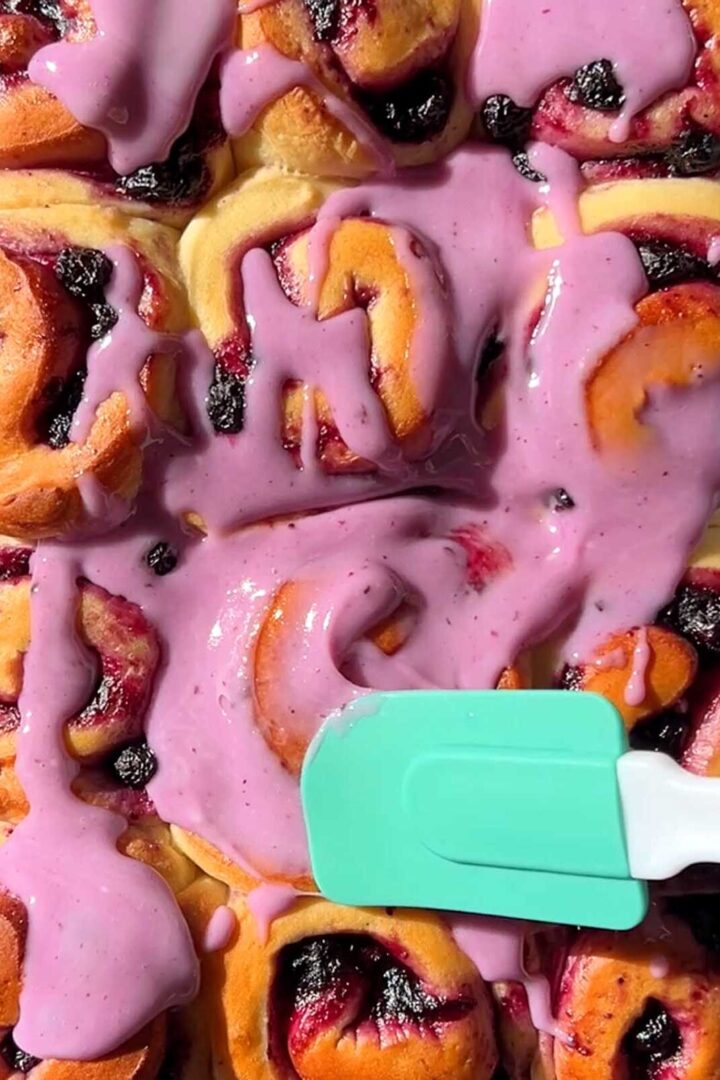
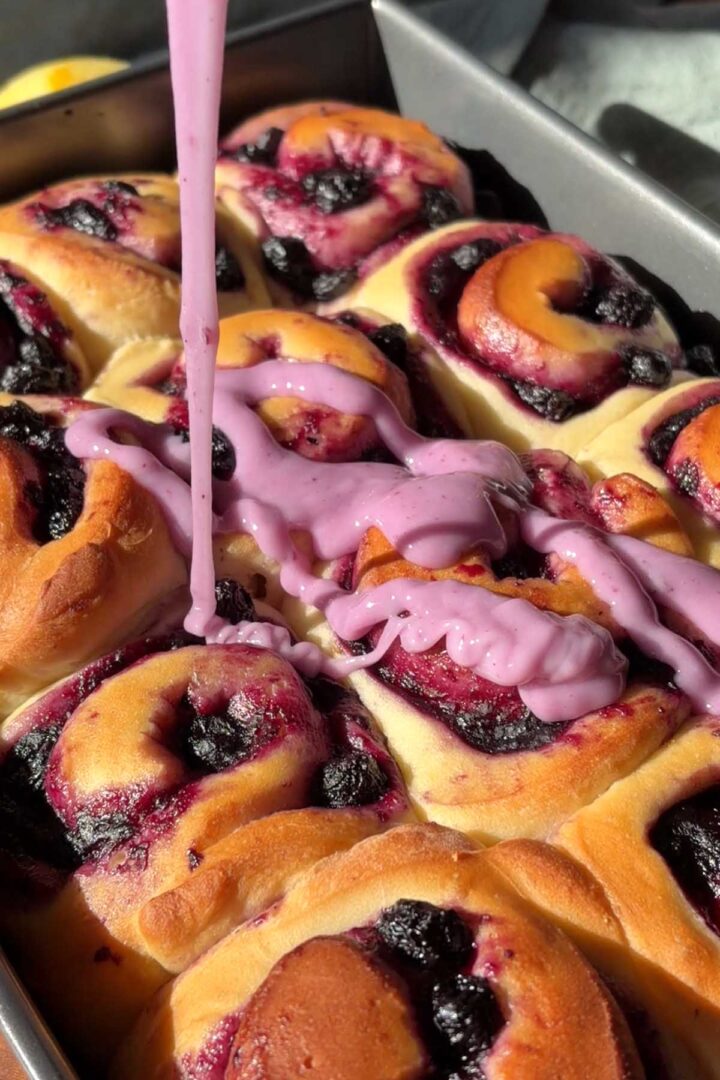
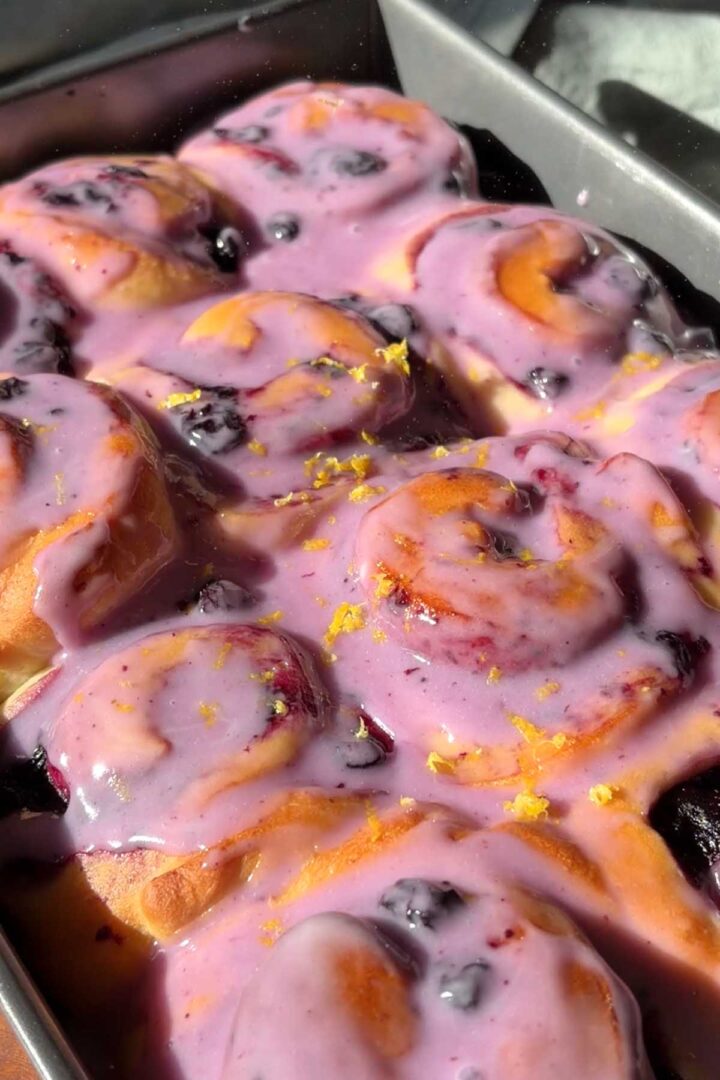
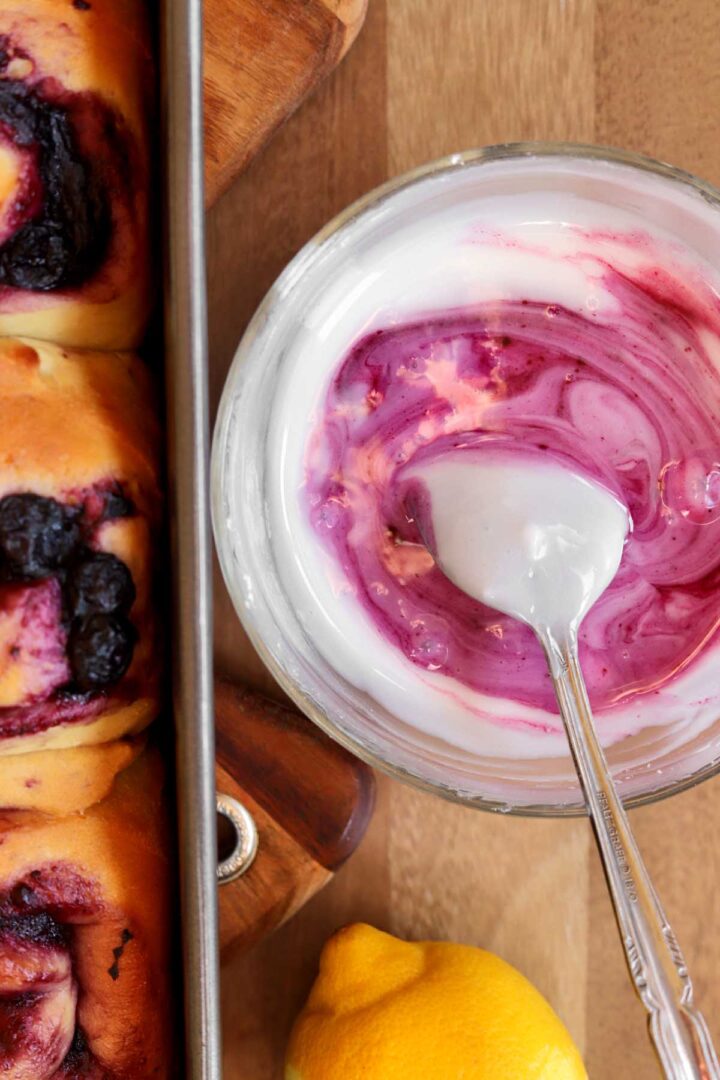
- STEP 10). Make the icing. Combine powdered sugar, yogurt, reserved blueberry sauce, vanilla and salt in a medium bowl and mix well with a whisk until very smooth. Drizzle it over each roll and dig in!
STEP BY STEP INSTRUCTIONS (watch the recipe video at the bottom of the page for a full tutorial)
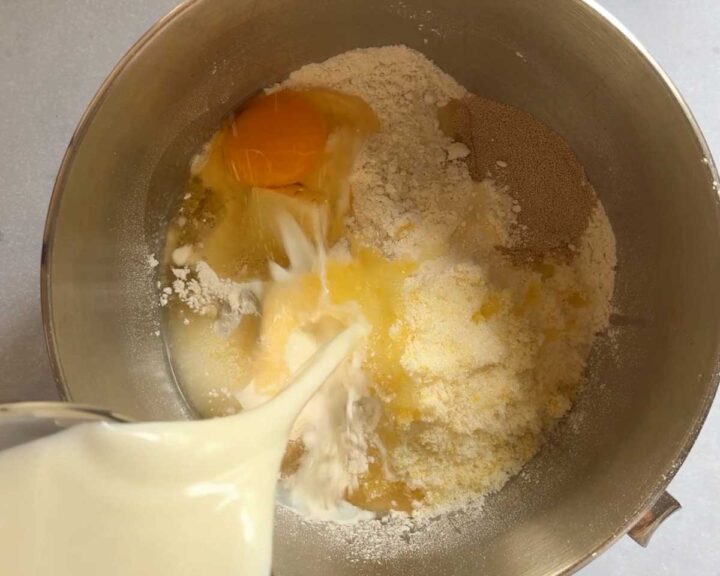
Combine all dough ingredients in a stand mixer bowl.

Mix with dough hook until ingredients are blended and dough forms.

Scrape around the bottom of the bowl to pull the dough away from the sides.

Continue mixing until dough is smooth, pulls away from the sides and stops "webbing" around the bottom of the bowl.

Knead the dough by hand. Stretch it out by pulling the sides outwards.

Knead the dough by hand. Fold the stretched dough back onto itself.

Roll the dough into a smooth ball.

Place the dough into a bowl to rise in a warm place. Lightly oil the surface and cover it.

Invert the risen dough onto a lightly floured work surface
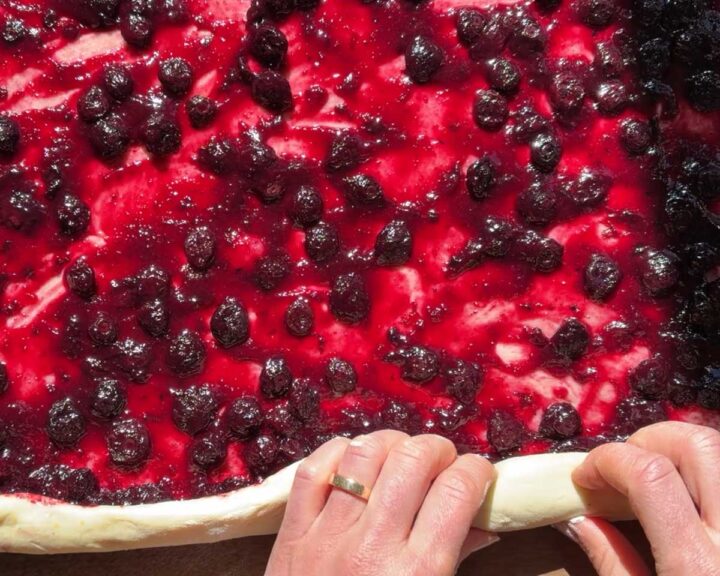
Roll up the dough gently.
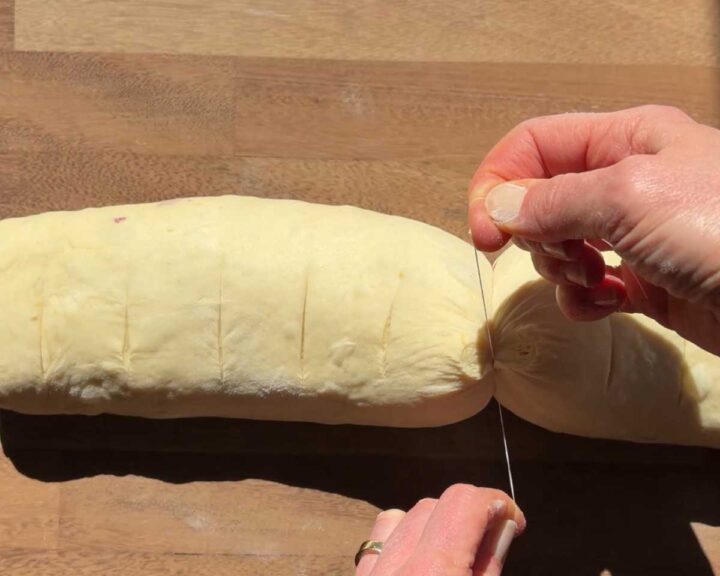
Make incisions to mark the places where you will slice the dough.
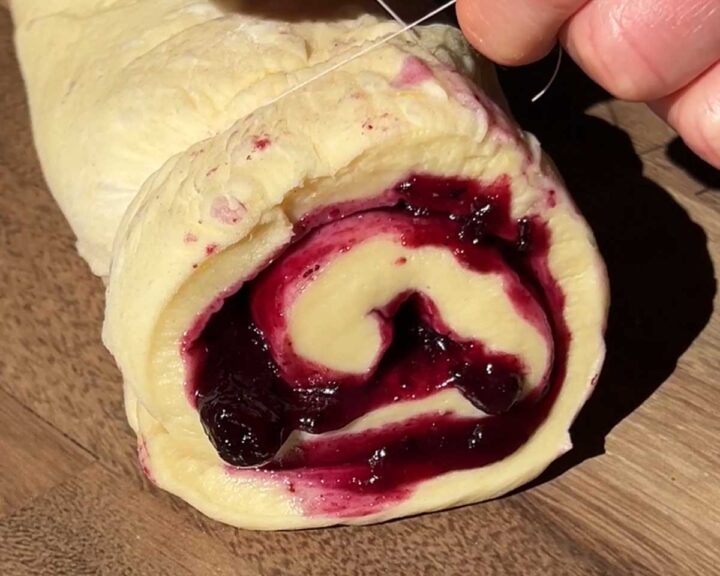
Use floss to slice through the dough.
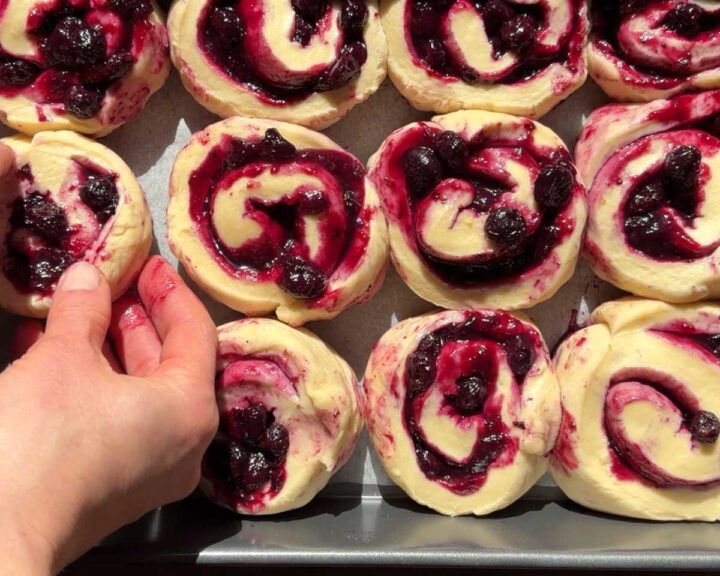
Place rolls into baking pan.
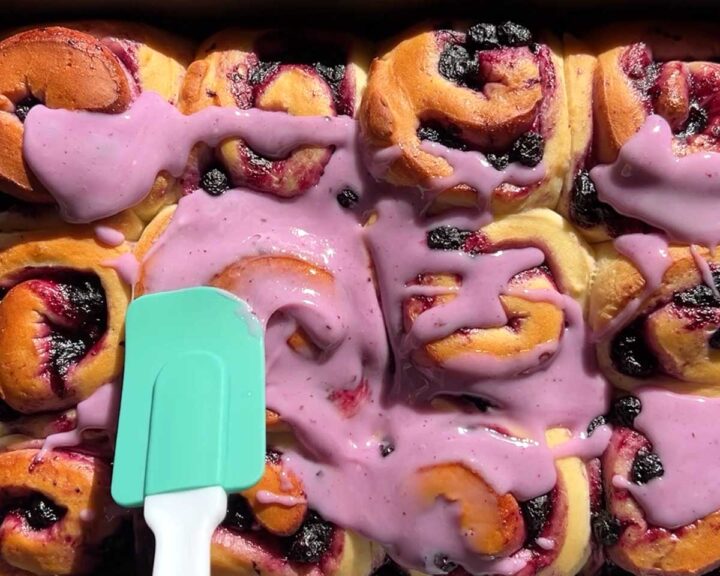
Spread icing over rolls.
EXPERT BAKING TIPS FOR THE BEST SWEET ROLLS
- Use fresh oil. Oil that is old can become rancid so be sure to use fresh oil that has a clean taste. Store oil in a cool, dark place away from the stove.
- Oil vs. butter: although butter tastes great, oil is a great ingredient for breads because it helps keep the crumb soft and it helps lubricate the gluten so that the dough has more volume during baking. This makes fluffier rolls.
- Have a well hydrated dough. This dough has 62% hydration which is a well hydrated dough for an enriched sweet dough such as these blueberry sweet rolls. You may be tempted to add more flour as you may feel it is a bit tacky, but this is correct. Conversely, different flours can absorb different amounts of water, so depending on the quality of your flour, you may need to increase hydration. A well developed hydrated dough will feel tacky, not sticky and it is the best way to ensure you have moist rolls.
- Don't over-heat the dough. Yeast thrives at 24-26 degrees C (75-79 degrees F) so don't let the dough get much hotter than this or it will suppress the yeast. The friction of the mixer often heats the dough alone, so I often even use room temperature water and don't even need warm water to make sweet roll dough in my stand mixer. If the temperature is too high, the dough will be sticky and it will proof too fast. A controlled temperature creates controlled fermentation for optimum flavor.
- Knead thoroughly. The dough should be smooth like a baby's bottom and will not tare when it is ready. A dough that is well developed will hold in the gas bubbles produced by yeast to yield fluffy rolls. This usually takes at least 10 minutes in a stand mixer on medium-low speed.
- Do not over-bake. Over baking will dry out any type of bread so watch the baking time after the 20 minute mark.
- Do not under-bake. Raw bread is not good. As important as it is to avoid over-baking, it is equally important to avoid under-baking as this will cause your rolls to collapse and sink in the middle. The dough will also be dense and pasty if it is undercooked.
- Cover the top of the rolls with foil if it browns too quickly. You can place a sheet of foil loosely over the rolls (like a tent) after the first 20 minutes of baking if they are getting too dark on top. This all depends on your oven since some ovens can be quite top heavy.
RECIPE FAQ
Any neutral tasting oil will work. I prefer sunflower oil for it's clean flavor profile.
You can use all butter in the dough in place of the oil, but note that the rolls will have slightly less volume. A bit of oil really makes a difference here and it is commonly used in the bakery industry to achieve better dough volume for fluffier bread.
These lemon blueberry rolls store well at room temperature for 1 day, and if you plan on having leftovers after that, I suggest refrigerating them for the next day since they have high moisture from the blueberry filling. You can also freezing them immediately to maintain freshness. Warm them up just slightly before enjoying.
If your rolls collapsed when you took them out then it is likely that the dough was over-proofed or under-baked.
Most likely the rolls would be dry if they are over-baked, not enough moisture in the dough (low hydration) or you have used too much flour for rolling and shaping.
No, I do not recommend pouring cream over the unbaked rolls. In fact, I think it is a waste of money. This has become trendy, but it is an unnecessary step that can make the rolls mushy and also slow their baking rate.
I always prefer metal pans for baking as they conduct heat faster and cook food more evenly. If you use a glass baking dish or a ceramic dish, then the rolls will need 5-10 minutes longer.
It is possible to leave the dough to "bulk" ferment slowly over night in the fridge. In this case, place the dough in a large bowl and cover it tightly with plastic. The next day, roll and shape it as directed.
Yes, you can perform an "overnight" process. Make the dough, roll it out, fill it and shape it as directed below in Steps 1-7 below in the late afternoon or evening. Place the rolls into the pan, cover tightly with plastic so they don't dry out and refrigerate. The next morning, bring them out and let them come to room temperature. If they have not fully risen, let them proof as required before baking as directed in the recipe card below. *Additional tip: if you live in a warm climate, work quickly to get the shaped rolls into the fridge because if they proof a lot during forming, they could end up over-proofing in the fridge overnight. In contrast, if the rolled dough pieces are really cold going into a cold fridge, they might not rise much overnight and will require further proofing time in the morning.
Yes you can, but you will need to proof or "bloom" the yeast before adding to the dough. You can do this by adding the active yeast to a portion of the milk that is warmed with a pinch of sugar. When it is frothy, then add it to the remaining ingredients in the bowl just before mixing.
If your dough is not rising, you may have used active yeast instead of instant active yeast, the yeast was too old, or the dough and/or surrounding environment is too cold. Yeast that is too old will lose the ability to leaven the dough and can even cause the dough to become more sticky. Its activity is highly dependent on temperature, so it is important to have a final dough temperature between 24-26 degrees (75-79 degrees F). If the dough is too cold, or kept in a very cool place, the yeast will ferment very slowly and proof times may be very long.
If you love making loaf cakes, check out these recipes!
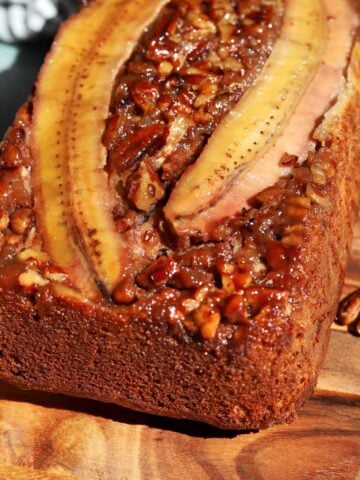
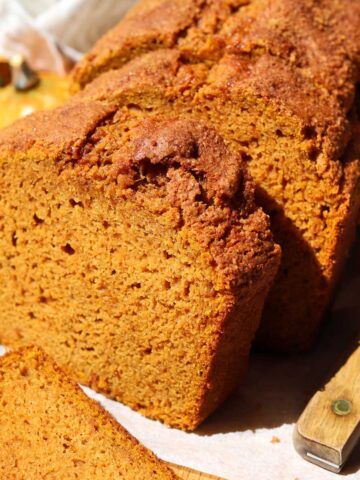
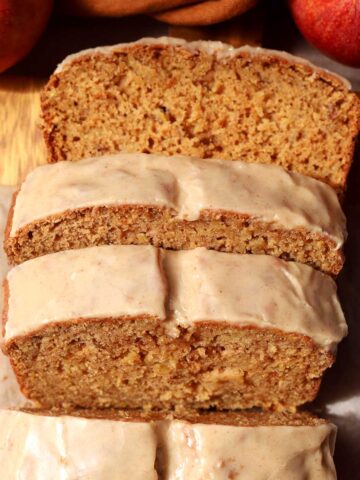
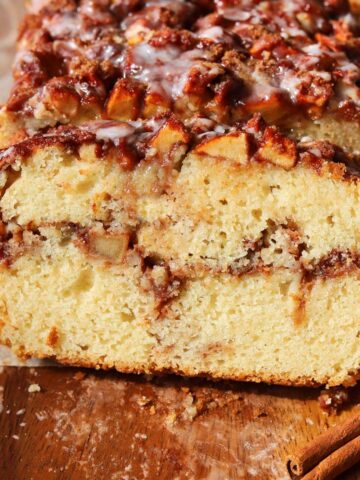
Walnut Chocolate Chip Zucchini Bread Brown Butter Chocolate Chip Pumpkin Bread Best Chocolate Chip Banana Bread Copycat Starbucks Lemon Loaf Apple Cinnamon Bread with Maple Crumble Double Chocolate Loaf Cake DOUBLE CHOCOLATE ZUCCHINI BREAD CLASSIC BANANA BREAD RECIPE MAPLE PECAN BANANA BREAD WITH DARK CHOCOLATE DOUBLE CHOCOLATE BANANA BREADLoaf recipes...
Here are some of my favorite loaf/bread recipes:
Lemon Blueberry Sweet Rolls

Ingredients
Blueberry Filling:
- 2 ½ cups (320g) frozen blueberries
- 6 tablespoon (80g) granulated sugar
- 1 ½ tablespoon (22ml) lemon juice
- 1 ½ tablespoon (12g) corn starch
- 1 tablespoon (15ml) water
Lemon Sweet Roll Dough:
- ⅓ cup (65g) granulated sugar
- 1 tablespoon lemon zest
- 4 cups (568g) unbleached bread flour, plus more as needed for rolling and shaping
- 3 teaspoon (11g) instant quick-rise dry yeast
- 1 ¼ teaspoon (10g) fine table salt*
- 1 large egg at room temperature
- 2 tablespoon (24g) liquid oil such as vegetable, canola, sunflower or olive oil
- 2 tablespoon (28g) salted butter, softened
- 1 ¼ cups (300ml) milk (whole milk or 2% preferred)
- more water as necessary for the dough if baking in drier months
Lemon Blueberry Icing:
- 1 cup (120g) powdered sugar
- 2 tablespoon (30ml) full fat plain yogurt
- 1 tablespoon (15ml) reserved blueberry sauce
- ¼ teaspoon pure vanilla extract
- fresh lemon zest for topping
- pinch of salt
*you can also use Kosher salt but then be sure to measure 10g by weight as it is lighter (has a lower density) than table salt. You will need around 2 teaspoons of Kosher salt.
Instructions
- Make the blueberry filling. Combine blueberries, granulated sugar and lemon juice together in a small saucepan or saucier over medium heat. Cook for 5-8 minutes stirring often until the berries are thawed and they release their vibrant juices.
- Mix in corn starch slurry. Mix water with cornstarch in a very small bowl. Once the berries have broken down a bit and are simmering, add the cornstarch mixture and stir it in.
- Cook until thick. Continue to cook and stir until it begins to bubble and thicken. Once bubbling, cook for 15 seconds.
- Cool. Immediately pour the filling into a clean bowl and let cool completely at room temperature, then refrigerate for 1 hour until thoroughly chilled and set before using. Cover and store for up to 1 week in the refrigerator.
- Make the dough. Combine sugar and lemon zest in a medium bowl and rub it together until fragrant and pale yellow in color so the essential oils coat the sugar crystals. Place flour in the bowl of a stand mixer. Add in lemon sugar, yeast and salt in little piles in separate places over the flour in the bowl so that they are not touching. See my video above the recipe card. The point is that you do not want the salt in direct contact with the yeast for a prolonged period of time without mixing or it can inhibit its activity.
- Add in the egg, oil, milk and soft butter. Attach the dough hook and mix on medium-low for 10-15 minutes. Stop after a 2 minutes to scrape down the sides of the bowl and ensure all of the flour is incorporated and the dough is a uniform mixture. It will still be wet and rather loose at this point. Continue mixing for another 2-3 minutes. The dough should start to climb up the dough hook and will still be webbing around the bottom of the bowl. (Note: if the dough seems rather dry and stiff at this point, add water at 10ml increments until you reach a softer consistency as described). Stop the mixer and scrape around the inside of the bowl to release the dough. Continue mixing for another 3 minutes. Stop again, pull the dough off of the hook and scrape around the inside of the bowl to release the dough again. Continue mixing for another 3-5 minutes. At this point the dough should start forming a mass and come away from the bowl as it is mixing. You can check the temperature of the dough now if you have a digital thermometer - it should be between 24-26 degrees (75-79 degrees F) for optimal activity.
- Transfer the dough to a lightly floured work surface. Now you will stretch and fold the dough to help develop the gluten structure so the rolls will be soft and fluffy. Using both hands, grab both sides of the dough, pull it outwards (this is the "stretch"), then fold it inwards over itself. Rotate the dough and continue to stretch and fold until the dough feels very smooth. Watch my video for a full tutorial. Shape the dough into a ball by tucking the sides underneath and rolling it around the counter The surface of the dough ball should pull smoothly without tearing.
- Let the dough rise. Place the ball into a bowl and then rub a little bit of oil lightly over the surface with your hands to prevent it from drying out. Cover the bowl with plastic and then cover with a kitchen towel. Set it aside in a warm dark place and let it rise for 1-2 hours until nearly tripled in size. Note that the amount of time required will depend on the temperature of your kitchen. After it has risen, place it in the fridge for 15 minutes to let it firm up slightly so it is easier to roll. Note, if you are making these in a very cool climate, then this step isn't necessary.
- While the dough is rising, prepare the pan. Lightly grease the sides of a 13x9-inch metal baking pan with cooking spray or soft butter and line the base with parchment paper.
- When the dough is finished rising, place it in the fridge for 20 minutes. This will help you roll it and keep it firm since the filling is wet and it will make rolling and slicing much easier. Trust me!
- Roll out the dough. Lightly flour a work surface to cover a large area. Carefully invert the bowl and tip the dough out onto the surface. Let the dough gently release from the bowl and plop onto the counter. Do not knead it any more at this point. Gently pull on the dough and stretch it out into a rectangle shape, then use a rolling pin to roll it out to a 13x16 inch rectangle. Gently apply the filling, spreading it out leaving about ½-inch border using a large offset spatula. Now you can either roll it up into a log and slice the log into 12 portions, or slice the rolled dough into 12 long strips (just over an inch thick) and then roll up each individual strip into a scroll. NOTE: This is messy! Don't be scared and embrace the mess. As you roll and slice the blueberry filling will squeeze out a bit and the dough will feel soft, but just gently lift them up and place them into the pan as neatly as you can. Don't worry about them looking perfect because when they bake, they will fill out and be beautiful. I recommend using floss to slice them since a knife will squish the soft dough with the wet filling.
- Place each roll spiral-side-up into the prepared pan so they fit nicely next to each other. Cover the pan loosely with plastic and proof for 30 minutes to 1 hour. Note: this proof time highly depends on the temperature of your dough and temperature of your room. The rolls are ready for baking when you press on the side gently with your finger tip and it slowly springs back, leaving just the slightest imprint. If your fingerprint remains and leaves a deep imprint, then the dough is over-proofed.
- While the rolls are rising, preheat the oven to 350°F.
- Bake for 23-27 minutes until evenly golden and the center roll is cooked through. The internal temperature should be between 92 and 94°C (198-201 degrees F).
- Transfer pan to a wire rack and let rolls cool for at least 20 minutes.
- Meanwhile make the icing. Combine powdered sugar, yogurt, reserved blueberry sauce, vanilla and salt in a medium bowl and mix well with a whisk until very smooth. Drizzle it over each roll and dig in!

Curious, there is no measurement of salt in the recipe for the icing portion. Should it be a pinch?
Hi Virgene! Yes, a pinch of salt.
How would I store these? In the fridge if I have leftovers? Do you keep these covered on the counter?
Hi Jennell! These lemon blueberry rolls store well at room temperature for 1 day, and if you plan on having leftovers after that, I suggest refrigerating them for the next day since they have high moisture from the blueberry filling. You can also freezing them immediately to maintain freshness. Warm them up just slightly before enjoying.
In step 10 above, there is a reference to making the icing with cream cheese. Is this an option to replace the yogurt that is listed in the ingredients and additional directions? Thanks!
Hi Michelle! Sorry that was an error, however you can use the frosting recipe from my Cinnamon Rolls recipe and add some of the reserved blueberry sauce if you want cream cheese in the frosting.
These were so good! They were even tastier the next day (imo). I love the fact that they are not too sweet and that the “icing” is made with yogurt. Which I always have on hand. The added touch of the lemon zest really elevated the bites of deliciousness.
Thank you so much! I'm glad you enjoyed them.
Could I make this dough and then put it in the fridge overnight to then use in the morning? Or would it be overproofed ?
Hi Sal! Yes you can.
Looks amazing! Would it be ok to substitute active dry yeast instead of quick rise yeast?
Hi Lacey! Yes you can, but you will need to proof or "bloom" the yeast before adding to the dough. You can do this by adding the active yeast to a portion of the milk that is warmed with a pinch of sugar. When it is frothy, then add it to the remaining ingredients in the bowl just before mixing.
I wasn’t able to see the ingredients measurements? Where can I found them on the site
Hi Kayleeann! It is near the bottom of the page in the recipe card. You can click "jump to recipe" to get there immediately.
Thank you! Can’t wait to try this recipe.
Amazing! Would love to hear your feedback after you make them:)
I was nervous about the proof step, but glad it came out beautiful and delicious!
Thank you Vivs! Glad they were a success 🙂
The dough unfortunately didn't raise despite me following all the steps.
Hi Eve! Sorry to hear that. If you are not getting any rise or gas production. It must be related to your yeast. Either your yeast is dead or you did not achieve a warm enough final dough temperature. Also ensure you use instant active yeast, as non-instant yeast will require blooming.
Your instructions were very clear and the results were amazing!
Thank you Amy!
Great recipe. Thorough. Very user friendly. Also………..DELICIOUS!
Thank you so much Larry! Glad you enjoyed the recipe 🙂
I made these early this morning and my family devoured them! They're as delicious as they are beautiful and I can't wait to make them again for Easter.
Thanks for the feedback Melissa! I'm so glad you and your family enjoyed the sweet rolls! 🙂
Would these freeze ok?
Hi Norma! Yes you can freeze the baked rolls in an airtight container or bag.
Could we substitute frozen blueberries for frozen strawberries instead?
Hi Geordyn! I haven't tested it but I think it could work. The finished filling needs to be quite thick so you may need to increase cornstarch.